
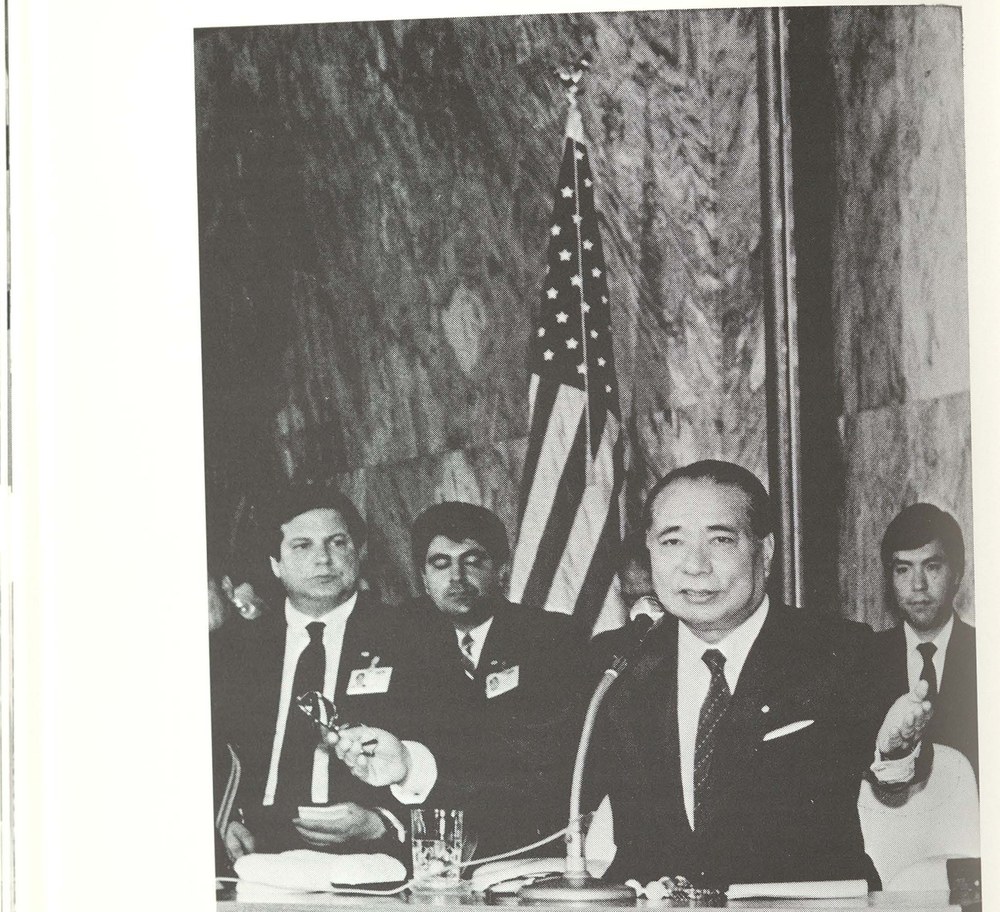
SGI President Daisaku Ikeda discusses principles of Buddhist practice with NSA members in Santa Monica, California.
An Overview of the SGI
A History of the Soka Gakkai International
At a meeting in Guam in 1975, representatives of some fifty-one nations gathered to create the Soka Gakkai International (SGI), an umbrella organization for all Nichiren Shoshu Buddhist lay organizations throughout the world. As the years have passed, this organization has taken on added significance as the international movement itself has gained momentum. Daisaku Ikeda, third president of the Soka Gakkai lay organization in Japan and now Soka Gakkai International president, has in the past few years traveled extensively throughout the world under the aegis of the SGI to carry the Buddhist message of peace and hope to troubled peoples.
True Buddhism began in Japan. Nichiren Daishonin was the founder of the religion, and several centuries later, in 1930, a Japanese educator named Tsunesaburo Makiguchi formed a lay organization based on faith in Nichiren Daishonin’s teachings. That organization is now known as the Soka Gakkai, which has a membership of some ten million and which works in concert with the Nichiren Shoshu priesthood to carry out the will of the Daishonin.
During World War II, however, Mr. Makiguchi was thrown in prison where he died for his pacifistic beliefs. After being released from his own wrongful imprisonment, his disciple, Josei Toda, took over the reins of the organization. By the time of his death in 1958, Toda had fostered the Soka Gakkai into a unified, nationwide network of more than 700,000 people. It was up to Toda’s closest disciple, Daisaku Ikeda, to oversee the subsequent development of the organization. In 1975, Mr. Ikeda assumed leadership of the SGI in addition to his responsibilities for the Soka Gakkai, and in 1979, largely to devote himself to the global movement, he resigned as third president of the Soka Gakkai, retaining the title of honorary president.
It was only natural that Mr. Ikeda would become the driving force for the worldwide movement, for he had been the one who first had journeyed abroad to foster lay organizations in countries outside Japan. In 1960, he made his initial trip, visiting North and South America. As a result, NSA (Nichiren Shoshu Soka Gakkai of America) was created, along with organizations in Brazil and Canada. Further journeys consolidated the lay movement in other countries.
In addition to his efforts to aid the formation of lay organizations, Mr. Ikeda has met with heads of government and cultural leaders in nations across the globe. He has been to the Soviet Union and China on several occasions and has hosted foreign dignitaries on their visits to Japan. And it is to Daisaku Ikeda the man and his dream—to establish harmony and mutual understanding among all the peoples of the world—that the next section is devoted.
Profile of Daisaku Ikeda
More than anything else, Daisaku Ikeda, president of the Soka Gakkai International and honorary president of the Soka Gakkai, is a man of peace. His thinking starts from the principle that war is absolutely impermissible, and that military preparedness, far from being a deterrent to war, actually poses the risk of a holocaust that could wipe humanity from the face of the earth. To his mind, the fundamental requisite for permanent world peace is mutual understanding and friendship between peoples of the various nations of the world. By this, he does not mean just political or economic agreements, though these are desirable; instead, he envisions friendships among the common people of the world that link them heart to heart in a mutual quest for peace, prosperity and happiness—friendships that bridge all national, racial and ideological boundaries. Born in 1928, Mr. Ikeda was only nine when the Sino-Japanese War began. He did not actually serve during World War II, but two of his most vivid recollections are connected with that war. One is the news of his brother’s death on the battlefield, and the other is the look of grief on his mother’s face when she learned that her eldest son had been killed. His attitude is succinctly stated in the opening of his eleven-volume (and still uncompleted) history of the Soka Gakkai, The Human Revolution: “War is barbarous and inhuman. Nothing is more cruel, nothing more tragic.”
Mr. Ikeda is by no means uninterested in political or economic relations among nations, but he feels that the truly important task today is to develop international exchanges in the fields of education and culture. In his journeys to the United States, China, the Soviet Union, India and the various countries of Asia, Western Europe, Central and South America, he has tried diligently to find points of mutual interest and agreement that can serve as a basis for closer ties at the popular level.
As the founder of Soka University near Tokyo, he is vitally concerned with the exchange of ideas, as well as the exchange of students and professors, between universities in different countries. In the past few years, he has visited more than twenty major universities, including Oxford, Cambridge, the University of Paris, Columbia, the University of Chicago, the University of California at Berkeley and Los Angeles, Beijing University, Fudan University, Universidad Nacional Mayor de San Marcos de Lima, Moscow State University, University of Delhi, Jawaharlal Nehru University and Sofia State University. At each of these centers of learning, he has not only held discussions with administrative and faculty members but also had opportunities to associate with the students and question them directly about their lives, opinions and ambitions.
Mr. Ikeda likes people and he makes himself at home wherever he goes, whether it be Denver, Colorado, or Lima, Peru. He has been made an honorary citizen of forty-nine foreign cities, many of which have given him citations of merit. The fifty-four-year-old ambassador of goodwill thinks of himself not as an ideologue, but primarily as one human being working for peace. To him, people are more important than ideology. He is acutely aware that whatever a person might believe, he is still a human being deserving of respect.
In that connection, he has repeatedly stressed working together with the common people of the world. At the Soka Gakkai’s Thirty-ninth General Meeting on October 24, 1976, he established the following five points as the fixed and unchanging definition of the Soka Gakkai spirit:
• That the Soka Gakkai shall forever stand on the side of the common people of the world.
• That the Soka Gakkai shall devote itself to carrying out the movement for human revolution.
• That the Soka Gakkai shall forever walk the great Middle Way of Buddhism.
• That the social aim of the Soka Gakkai shall be to preserve peace and to work for the advancement of true human culture.
• That the Soka Gakkai shall guard to the end the freedom of the human spirit, and in particular the principle of religious freedom.
As the leader of a great Buddhist lay organization, Mr. Ikeda is a diligent teacher and student of Buddhist philosophy, in particular, the philosophy of life and compassion handed down by Nichiren Daishonin. Indeed, his every thought and act is founded on Buddhism, which he regards as the sole true religion for peace, but he does not seek to impose his faith on others. He believes, as the Buddhism of Nichiren Daishonin teaches, that each single life is of the utmost importance, and that our prime duty is to respect and protect the right of each person to live.
As a nineteen-year-old, Daisaku Ikeda joined the Soka Gakkai in August 1947, during a period when Japan was in the throes of defeat and despair. The turning point for Mr. Ikeda came when he met Josei Toda, who during the war had been imprisoned for two years because of his opposition to the Japanese military establishment, and who was then reorganizing the Soka Gakkai. Young
Daisaku was so impressed by Mr. Toda’s faith and character that he became a loyal and active disciple. He still speaks of Mr. Toda as “my teacher in life.” He studied under Mr. Toda for the next eleven years, succeeding to the presidency of the Soka Gakkai on May 3, 1960, two years after his mentor’s passing.
Mz. Ikeda is a prolific writer and poet, and he is a great admirer of the poetry of Walt Whitman. Using the Japanese haiku style of poetry, Mr. Ikeda will dash off a poem on the spot to encourage and praise someone he has met. His continuing work, The Human Revolution, uses a novel format to tell the tale of the Soka Gakkai’s vast movement for peace and culture. Each volume has sold more than one million copies.
In his writings, Mr. Ikeda thoroughly elucidates his belief that permanent world peace can be achieved only if nations subordinate their individual interests to the common cause of mankind. In volume four of The Human Revolution, he proposed a world summit conference for the abolition of nuclear weapons, and in volume five, he recommended that Japan attempt to make treaties of peace with every country, particularly the People’s Republic of China.
He has continually stressed that Buddhists have a sacred duty to work for world peace. In an address delivered at the Thirty-fifth General Meeting of the Soka Gakkai on November 2, 1972, he said:
The most horrible of war’s aspects is probably not the cruelty and evil of its effects, but the fact that it brings to the forefront the vilest, most atrocious elements of the human life-force. War strips nobility and respect from humanity, and, through its wicked actions, covers man with filth. It is only natural that Buddhism, the aim of which is to guide all people to the highest, purest realms, is bound to engage in direct combat with war. By a like token, the Buddhist believer who is eager to practice his faith in the truest way regards it as his mission to pour his entire soul into the task of building peace.
Mr. Ikeda strongly believes that the United Nations should be accorded far greater powers than it now possesses. He feels the U.N. is impotent because it lacks the strength to impose its decisions on the two superpowers, the United States and the Soviet Union. In Hawaii in August 1981, Mr. Ikeda presided over the second annual general meeting of the Soka Gakkai International, and he again took up the theme of nuclear weaponry and the United Nations’ role in world peace. He said:
Recent arguments over how to wage a first strike to gain victory obviously imply the framing of strategic programs in which nuclear weapons are no longer thought to be “unusable” but “usable.” The recently introduced neutron bomb, which is frowned upon by those who desire peace, is capable of instantaneously annihilating man without devastating buildings, is only an extension of the same old argument—an inevitable product of an argument based upon distrust, hatred and fear. For this reason, do you not agree that ours is the very age which requires a strenuous effort to unveil the essential evil of nuclear weapons?
Although I feel that the United Nations is still too ridden with defects and faults to further advance toward peace, I would nonetheless like to ask all of you, for the sake of world peace, to strengthen your support for this organization, respecting its spirit as defined in its charter, and to launch a promotional and informational campaign to bolster and enhance the United Nations so that it can be an effective vehicle for perpetual peace on this planet.
The Soka Gakkai was founded on Tsunesaburo Makiguchi’s system of value-creating education, and in the nineteen years of Mr. Ikeda’s tenure as president (he resigned in 1979 to devote himself to the Soka Gakkai International, retaining the title of honorary president of the Soka Gakkai), the organization put considerable effort into the cause of liberal education. Soka University, which he founded along with several elementary, junior high and senior high schools, has placed itself at the forefront of this movement.
Mr. Ikeda has even conceived of a United Nations for Education, which would operate as a thoroughly non-political conference of educators, student representatives, parents’ representatives and cultural leaders from all over the world, functioning to promote educational exchange, to provide financial aid or technical aid where needed, and in general to fulfill the purposes for which UNESCO was established. He has proposed to a number of foreign educators that a beginning could be made by establishing an International Conference of University Presidents and an International Conference of Student Representatives.
He is a great believer in the need for personal dialogues between leaders from different cultural areas.
Particularly noteworthy were his extended conversations with the late Dr. Toynbee in London in 1972 and 1973, which covered topics ranging from the human being as a social animal to the nature of life and the role of religion in the modern world. These dialogues have been published in book form in Japanese (1975), English (1976), Spanish (1980) and French (1981).
Mr. Ikeda has resolved to spend as much time as possible traveling to various countries in the interest of peace and international goodwill; he has made more than thirty overseas trips, visiting some forty nations. Traveling to different countries gives him the opportunity to engage in which he calls “human diplomacy,” by which he means person-to-person diplomacy. Wherever he goes, he talks not only with political and cultural leaders, but with as many of the ordinary people as possible. Fundamentally, he believes that the most important people are the ordinary people.
In the world today, it would be difficult to find a person who has devoted so much time and sincerity to the cause of world peace. “If I can contribute even in a small way to the achievement of permanent peace,” he says, “I shall be happy to travel here and there about the world for the rest of my life.”
In sum, Daisaku Ikeda is, more than anything else, a man committed to peace.