
4
Living as a Buddhist
The Quest for Enlightenment
Having thus far focused upon the prescribed practice and theoretical explanations that form the basis of Nichiren Shoshu Buddhism, we now turn our attention to the third and most important criterion by which to judge a religion— that of actual proof. It is this standard that concerns itself with the real-life application and results of religious practice and theory. Ultimately, the result of the Buddhist faith for each person who practices it is said to be enlightenment. Now, enlightenment is a concept which has been expounded upon and argued about for as long as mankind has been cognizant of how much it did not know. The enlightenment of Nichiren Shoshu is so profound that it defies verbal description. Nevertheless, it could be said to encompass a number of dimensions. On one level, enlightenment might be defined as a life-condition of absolute happiness and confidence about life. On this level, not only are all of life’s ramifications at the present moment completely understood, but as a result of such total awareness, causes can be made to insure a joyous and secure future. Because Buddhism speaks of the oneness of mind and body as well as the inseparability of the person and the environment, the Buddhist definition of enlightenment must also take these concepts into account. In other words, the enlightenment of Nichiren Shoshu is in no way limited to the spiritual realm. A person’s enlightenment is not only reflected in his or her emotional confidence level or profound wisdom about the universe and life. That enlightenment must, by definition, also be evident in such areas as material fortune and physical health. Perhaps even more important, the enlightenment of the Nichiren Shoshu believer is something that reaches far beyond the limited realm of his or her immediate environment. The greatest impact of Buddhist enlightenment is that it is employed to actually enlighten others. From the standpoint of the Mahayana Buddhist tradition— expounded by all Buddhas, from Shakyamuni to Nichiren Daishonin—the ultimate goal of the Buddhist religion is the shared enlightenment of all humanity. This shared enlightenment, it is believed, will eventually manifest itself in a world of human beings at peace with themselves and living in harmony with nature.
Obviously, enlightenment, when expressed in such terms as the preceding, is a goal which seems both lofty and distant. Nevertheless, it is a real-life goal and, as such, is distinctly different from the afterlife or spiritually intangible objectives often expressed as the greatest promises of more traditional Western religions. Also, in the actual daily practice of Buddhism, much more emphasis is placed on the process of living than its end result. The Buddhist approach is entirely common sense. In fact, it is in the occurrence of significant daily events that the actual proof of the Buddhist faith shines for the practitioner.
Pursuit of Desires
The process of living as a Buddhist has come to be known as human revolution. This human revolution is considered by Buddhists to be the fundamental revolution— the change of life which must occur as a catalyst to all other change, be it social, political, environmental or whatever. Human revolution entails both the elevation of one’s basic life-condition and the undertaking of positive action as a prerequisite to any external change.
The process of human revolution is, of course, based on faith in the Buddhist practice and its course is defined by one’s own needs and desires. This latter aspect is a most unique feature of the Nichiren Shoshu faith. In many Western religions which focus on the existence of a transcendent God, one is encouraged to live life in accordance with the desires of God rather than being swayed by more personal, implicitly selfish motivations. God-fearing people often end up doing more what they think they should do than what they want to do.
Similarly, earlier Buddhist teachings, known as the Theravada school, also urged the suppression of personal desires for the accomplishment of a holy purpose. The rationale behind this was that our senses tend to delude us with regard to the world around us. Since our senses are functions of our body, early Buddhism proposed that suppression of earthly desires—desires associated with bodily needs such as hunger, shelter, sex, and so on—would negate the detrimental aspects of physical existence and allow the human being to manifest his or her full spiritual potential.
Nichiren Daishonin’s Buddhism, however, is a religion which teaches the oneness of mind and body. The idea of suppressing one’s earthly, physical desires for the attainment of some greater spiritual good is obviously contradictory to such an idea. True Buddhism does ask that the human being come to recognize the eternal aspect of his or her own life while perceiving the essential transience of all phenomena. Nevertheless, this awareness is something to be achieved on both a spiritual and a material plane.
Therefore, rather than demanding the suppression of desires as a prerequisite to attaining enlightenment, Nichiren Shoshu suggests that the very pursuit of those desires is what elevates one’s life-condition to an enlightened level. The fact that true Buddhism proposes that desires literally transform into enlightenment (bonno soku bodai) is what makes this religion accessible to every human being and provides the motivation to do human revolution. After all, each of us truly wants to pursue our desires.
Some might argue that a religion which proposes that man give free rein to his desires is being rather irresponsible. After all, have not experience and history shown us time and time again that man’s own ego tends to sow the seeds for his own destruction and create untold suffering for the generations which follow? It is in response to this concern that Buddhism holds fast to its essential premise—the inviolable dignity and Buddha nature of each and every single human being. The problem, Buddhism postulates, lies not in the essential nature of the human being but rather in the inability of the human to tap that nature. To this end, Nichiren Daishonin clarified Nam-myoho-renge-kyo as the core of human life and advocated chanting as the key to unlocking that core.
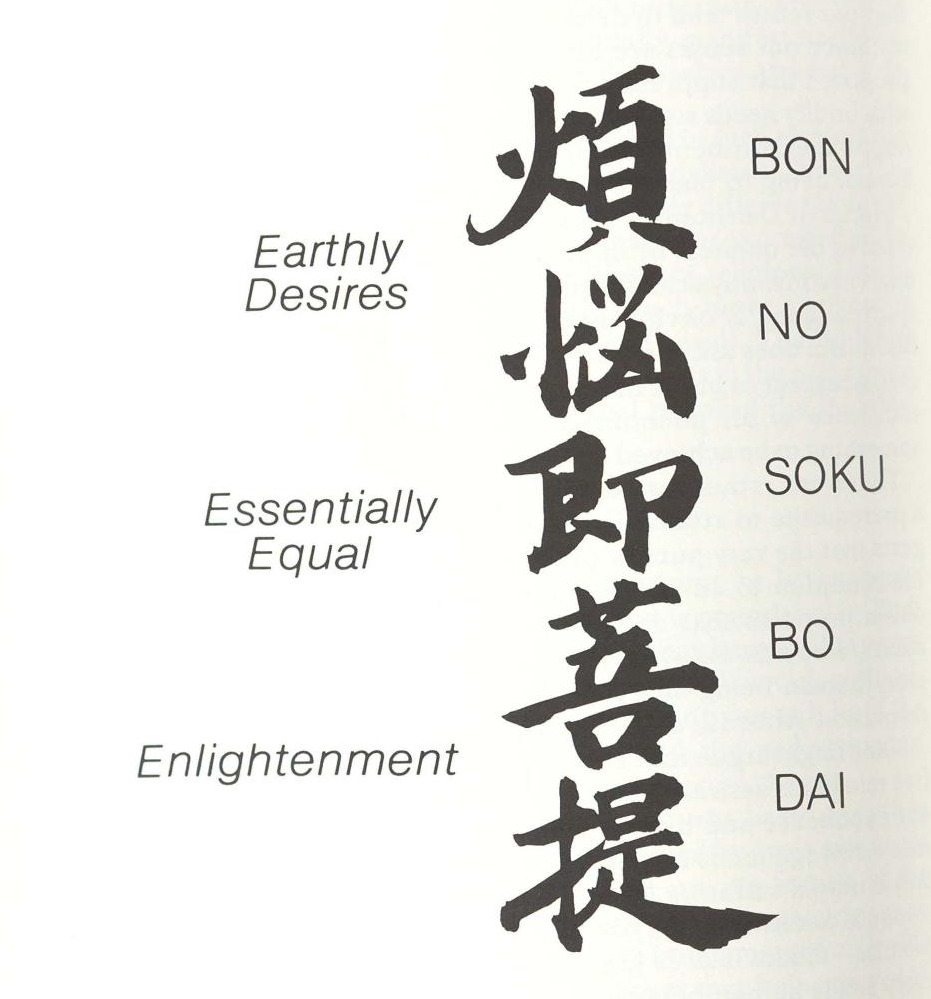
Buddhism submits that the tendency of the human being to give in to his or her baser tendencies and thus create disastrous future effects is not a function of some inherent human flaw. There is no original sin in Buddhism. Rather, human beings over the ages have become deluded with regard to the true nature of their own lives. They vest their fortune in some transcendent or vague concept of God or fate and thereby abdicate responsibility for their lives to someone or something else. Or they deny the existence of a greater reality altogether and think that simply living for the present, drawing the greatest sustenance they can from their immediate phenomenal reality, is what life is all about. In either case, the Daishonin would claim that human beings tend to delude themselves about the true nature of things and operate from a level of fundamental darkness or error (gampon-no mumyo).
In his writings, Nichiren Daishonin asks that we recognize the irrevocable reality that “the body is the palace of the ninth consciousness, the unchanging reality which reigns over all life’s functions.” What he is referring to is the unconscious reality of the Buddha nature that eternally exists within—the ultimate teaching of the Lotus Sutra that Nichiren Daishonin crystallized as Nam-myoho-renge-kyo.
Without going into a detailed explanation of the “nine consciousnesses” expounded in Buddhist theory, suffice it to say that the ninth consciousness is held to be the eternal, unchangeable essence in each of our lives. The eighth consciousness, on the other hand, is known as the “karma storehouse” wherein all the causes and effects of one’s life are stored. This is similar to the psychological school of thought which teaches that nothing is ever forgotten or discarded from one’s life. In any event, we are talking here about things which totally exist in the subconscious levels of human existence. The first seven consciousnesses deal with aspects of the conscious mind, such as the five senses, thinking, judgment, and so on. Buddhism, like psychology, explains that man’s conscious thought and mind are simply the tip of a far deeper iceberg.
The point here is that man’s incorrect tendencies and ideas stem from the eighth consciousness. They have been ingrained there by previous negative causes and teachings. The fundamental darkness of man’s life, therefore, rather than existing at the core of his being, is simply a dark or unenlightened area existing at very deep levels of his unconscious life. Chanting Nam-myoho-renge-kyo activates the “fundamental enlightenment” (gampon-no hossho) of the ninth consciousness, thereby illuminating that which was previously dark within the karma storehouse. The effect is similar to turning on the light in a dark attic. What was previously black and frightening is now illuminated and available for constructive use. Through the Buddhist practice, that within our lives which previously served to hurt us is transformed and becomes a force for the creation of value.
Developing the Highest Ego
It is on the basis of all of this that Buddhism teaches us to pursue our desires. Even if those desires emanate from a basically negative aspect of our being, the practice of Buddhism will illuminate that aspect and the law of cause and effect will clearly show what changes need to be made. The wisdom and effort to make those changes are the key elements of the human revolution—elements found within rather than provided from without.
Ultimately, the process of human revolution leads to the development of what Buddhism terms the “higher ego”—to be distinguished from the lower ego which has historically created so much of a problem for mankind. In a lecture given in 1974 at UCLA, Soka Gakkai International President Daisaku Ikeda expanded on this notion of the higher ego by saying:
We cannot say that it is stupid to be charmed by fleeting pleasures, or swayed by worldly desires. No. As long as life continues, it is instinctual to want to live, to cherish love and to seek profit.
A life dominated by desire or swayed by external influences is only a superficial expression of the human ego. Enlightenment or awareness of the universal truth underlying all phenomena brings out the most noble and rewarding ego.
The highest ego is the fundamental principle of the universe. It is also the same law which controls the expression of the self within each individual...
Pursuing this true ego does not imply giving up a lesser or more superficial one. The fact is that the highest ego gives new direction to the lesser one.
Civilization advances because of the instincts and desires of men. The pursuit of wealth enables economic growth. The will to defy the winter cold led to the development of natural science. Somehow, love, which is a desire, inspired literature.
Some schools of Buddhism teach the suppression of all earthly desire. Because they equate desires with the mortal flesh, they even condone self-immolation. However, desires arise from the innermost core of life. They are absolutely indestructible. They are the motivating force behind all behavior.
So, it is absolutely necessary to give direction to the superficial ego. This ego is only meaningful when based on the loftier ego. True Buddhism has clarified this highest ego as true human nature. I feel very strongly that our civilization will be able to make meaningful progress only if we understand this point.
As mentioned before, a Buddhist pursuing his or her desires and undergoing the process of human revolution in the quest for enlightenment keeps in mind not only personal fulfillment but also cherishes the hope for a shared enlightenment among all mankind. To this end, the higher ego requires that causes be made in the transpersonal as well as the individual realm. For the Nichiren Shoshu Buddhist, the greatest cause that can be made in order to share the enlightenment of Nam-myoho-renge-kyo is the giving of that teaching to another human being. Shakubuku, proselytizing in Nichiren Shoshu Buddhism, is more than just an attempt at enlarging the religious organization. The hope that each person can learn to tap the universal law that lies within, thereby initiating the human revolution on a worldwide level, provides the deepest rationale for shakubuku. Buddhists believe that only in the accomplishment of global human revolution can the salvation of all humankind be guaranteed.
Daisaku Ikeda has said that “a great revolution of character in just a single person will help achieve a change in the destiny of a nation and, further, will enable a change in the destiny of all mankind.” Although this statement may seem idealistic, almost to the extent of being naive in this day and age, it is still no less valid in the eyes of the Buddhist teaching. From more and more arenas of the human experience, evidence is accumulating which supports the concept of human revolution and points to it as perhaps the only factor which can pull civilization back from the brink of the abyss which it seems to be approaching.
Inflation, energy crises, ineffectual leadership and a host of other problems create an environment of chaos, presenting problems which often seem insoluble. Add to this the ever-present Damocles sword of nuclear warfare and it is difficult to know where to begin to make the challenge. Because these problems affect us on such an insidious psychological level—as opposed to the overt physical threat of actual war or even street crime—the human being tends to move his or her consciousness in the direction of solving these problems through the imagination of new structures, economics, politics, and so on.
This is the real threat—that our attention to changing environmental forms will rob us of the energy and creativity we need to change ourselves. This is not to say that efforts to change the environment are fruitless; rather, human beings must get their priorities straight and recognize that it is the development of their life-condition rather than their mentality that will ultimately solve the problem.
Toward Global Harmony
As the ultimate proof of its validity, Buddhism holds out the dream of a world at peace resulting from the individual human revolution of millions and millions of human beings around the globe. This dream is more than an ideal—it is a stated destination of the entire Buddhist movement. For the individual, the actuality of the Buddhist faith is manifest in the process we refer to as human revolution. For civilization as a whole, the ideals of the
Buddhist religion are reflected in an actual social movement known as kosen-rufu.
Kosen means to teach the Buddhist religion to all people, and rufu means that Buddhism is both well-known and sincerely practiced by people in society. Thus kosen indicates the propagation of
Buddhism, and rufu the condition which results from this propagation.
From the preceding definition of kosen-rufu, it might easily and mistakenly be assumed that kosen-rufu is a numerical goal, some pre-set percentage which, when reached, will assure a world at peace. However, kosen-rufu, as most other things in the Buddhist scheme of things, is essentially a process. Daisaku Ikeda described it as follows:
Kosen-rufu in no way means a goal. In the fundamental Buddhist sense of the word it is not accurate to regard kosen-rufu as something like a fixed terminus. The Daishonin’s Buddhism is a teaching of the True Cause, which means that true Buddhism is always moving toward the future. The Daishonin asserted therefore, that (his own) Kamakura era, also, was a time for kosen-rufu.
In addition, the Daishonin was indicating an eternal unceasing current of kosen-rufu when he said that Nam-myoho-renge-kyo will spread “for 10,000 years and more, throughout all eternity.” Kosen-rufu is not the terminus of a current, but the current itself, the pulsation in society of living Buddhism.
In short, religion constitutes the foundation of a culture, the soil on which humanity flourishes. When a sound religion is lost, culture decays, creating a great void inside humanity itself. . . . The loss of a sound religion is the very root of the evil which is gnawing at the vitals of modern civilization and culture. At this time of crisis, is it not our mission to build a new culture and revive society?
There are a number of examples in history which demonstrate the nourishment that an appropriate religious awakening gave to a people’s culture. In the ancient Indian country of Sravasti, a form of kosen-rufu was said to have been attained when one-third of the population practiced Buddhism, another third sympathized with it and the remainder were indifferent or opposed to it. All the people in the country were said to have enjoyed the happiness and prosperity of the culture.
In the first 500 years after the death of Shakyamuni, Ashoka the Great, who had unified all of India through military conquest, gave up war for pacifism. This was due to his conversion to Buddhism. Ashoka went on to establish the first public hospitals and parks, and dedicated his government’s efforts to the welfare of the people. He provided the opportunity for many to learn about
Buddhism and promoted its practice while maintaining religious freedom. During this period the culture of India reached a high level.
In the second millenium after Shakyamuni’s death, Chinese culture experienced an unprecedented prosperity after T’ien-t’ai converted the emperor as well as the ten most influential sects and had spread the teachings of the Lotus Sutra throughout the country. The Heian culture of Japan (794-1185 A.D.), which has known no equivalent in that country’s history, corresponds to the widespread introduction of T’ien-t’ai’s Buddhism by the great teacher Dengyo.
Now, in an era almost 3,000 years after Shakyamuni, Nichiren Shoshu members are working diligently for the construction of an eternal, global state of kosen-rufu based on the true Buddhism of Nichiren Daishonin. In the Buddhist’s mind, this is not some paradisiacal, utopian condition. Rather, kosen-rufu might be better described as an entopia—an ever more harmonious, evolving condition of global humanity. It is only natural that human minds will constantly move, and new generations will replace old. Conflict, turmoil and change are a permanent part of the human reality.
Kosen-rufu is not meant to imply an idyllic world in which there is no suffering or pain. Rather, Buddhists aim toward a world in which humans, rather than inflicting pain on one another, unite to face the common challenges that cause mankind to suffer as a whole. Rather than simply making laws to govern themselves, human beings should ideally be able to find the universal law within which will allow them not only to live in peace with one another, but also in peace with the planet from which they draw sustenance.
In his Gosho, Nichiren Daishonin says, “Regard suffering and joy as facts of life and continue to chant Nam-myoho-renge-kyo no matter what happens.” Ours will never be a world in which suffering completely vanishes; what Buddhism would have happen at the stage of kosen-rufu is that humanity share common suffering in the natural process of self-development, rather than inflict suffering upon itself in a headlong rush to self-destruction.
SGI President Ikeda once defined kosen-rufu as something like a second Renaissance. He said:
The ideal of the future must originate from religious faith deep in the human heart. The time has come to take first priority away from external authority and give it to the revolution that must take place in the heart of each human being. This must be the age of the second Renaissance. The ordinary individual human being must play the leading role in this Renaissance, and the battle he must fight is the struggle to transform his own life from within.
This, then, is the actual proof that the Nichiren Shoshu believer seeks in his or her own life—a victory in the battle for human revolution. A Buddhist practices faith with the awareness that, because of the oneness of life with the universe around it, a victory at a personal level will assure victory in the quest for kosen-rufu. This will be the greatest actual proof of all, for, as Nichiren Daishonin so poetically put it:
“In that time because all people chant Nam-myoho-renge-kyo together, the wind will not beleaguer the branches or boughs, nor will the rain fall hard enough to break a clod. . . . Disasters will be driven from the land, and the people will be rid of misfortune. They will also learn the way of living long, fulfilling lives. Realize that the time will come when the truth will be revealed that both the Person and the Law are unaging and eternal. There cannot be the slightest doubt about the sutra’s solemn promise of a peaceful life in this world.”
REFERENCES
Dialogue on Life, vol. 2. Daisaku Ikeda, Yoichi Kawada and Masahiro Kitagawa. Tokyo: Nichiren Shoshu International Center, 1977.
Outline of Buddhism. Yasuji Kirimura, ed. Tokyo: Nichiren Shoshu International Center, 1981.
Selected Lectures on the Gosho. Daisaku Ikeda. Tokyo: Nichiren Shoshu International Center, 1979.