
Basics of Buddhist Theory
The True Entity of All Phenomena
Theoretical proof, the second of the three criteria for evaluating religious teachings, means that, to be considered valid, a particular doctrine must be logically consistent and not contradict itself. In this chapter we will examine some of the basic aspects of the Buddhist theoretical framework. We have already explained in the preceding section how Nichiren Daishonin used the Lotus Sutra as a scriptural reference to support his teaching of Nam-myoho-renge-kyo. Similarly, in giving a theoretical rationale for his teaching, he drew on the philosophical system developed by the Great Teacher T’ien-t’ai on the basis of the Lotus Sutra.
The Lotus Sutra, as already mentioned, teaches that all beings are equally endowed with the Buddha nature and that all are therefore capable of attaining Buddhahood. The sutra conveys this message in several ways. Its first suggestion of a potential for universal enlightenment comes in a passage from the Hoben (second) chapter of the Lotus Sutra which refers to “the true entity of all phenomena” (Jap. shoho jisso). T’ien-t'ai used this passage as his scriptural authority in establishing his philosophical system.
People of every age have come repeatedly to the realization that phenomena in this world are fleeting and uncertain. This realization has prompted the search for an eternal, unchanging truth. Different teachings offer different explanations of the relationship between this absolute truth and the visible world that we experience. Some hold that the ultimate truth governs this world from a higher realm. Others say that it lies beyond or behind phenomena, or that phenomena are an illusion and the ultimate truth alone is real. According to the Lotus Sutra, the phenomena we perceive in everyday life and the ultimate reality are “two but not two.” All things, just as they are, are manifesting the true entity of life.
First, let us look at “all phenomena” and “the true entity” as “two.” Phenomena are those aspects of life which can be perceived through the senses or otherwise observed, measured, quantified, explained by reason or grasped with the mind. They are by nature manifold, transient and subject to change. The true entity, on the other hand, is that aspect of life that is one and only one, eternal and unchanging. It is the mystic dimension of life, beyond the reach of reason or the senses. However, these two differing aspects of life are also “not two”; it is impossible that they could ever exist independently. Phenomena are the manifestations of the true entity and so cannot exist without it, while the true entity lies nowhere apart from its phenomenal manifestations.
This concept, though somewhat difficult to grasp, has radical implications. First of all, if the true entity is manifested in all phenomena, then all people are equally endowed with the ultimate truth. All are thus capable of attaining Buddhahood and are inherently worthy of respect. Moreover, enlightenment cannot be confined to a special place, nor can it be the exclusive province of a single person or group of persons. Anyone, just as he is, can become a Buddha.
Three Thousand Worlds in a Single Life-Moment
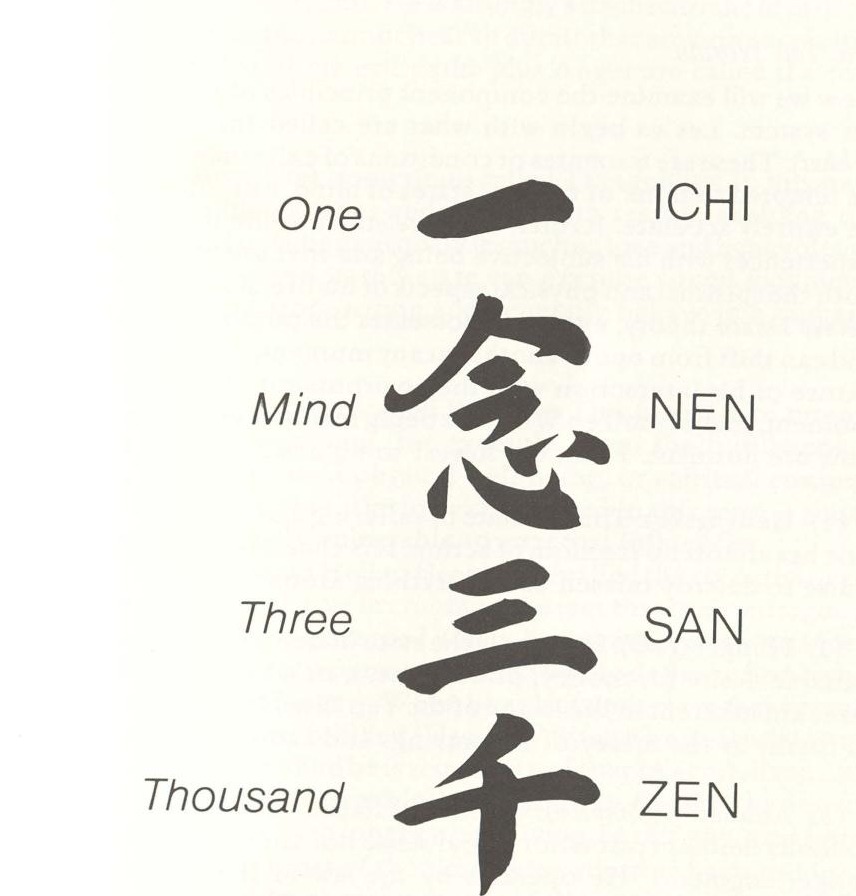
The concept of “the true entity of all phenomena” was developed and expanded by the Great Teacher T’ien-t’ai into a philosophical system called ichinen sanzen, or 3,000 realms in a single moment of life. Ichinen sanzen is a world view explaining the mutually inclusive relationship of all phenomena and the ultimate truth. Ichinen, or “one mind,” is also translated as the life-moment. It is the true entity of life at each moment. Sanzen, literally “three thousand,” represents the phenomenal world. Of course, there are more than 3,000 phenomena in the universe, as phenomena come in endless variety. The number 3,000 indicates the invariable laws according to which the true entity manifests itself as phenomena. This figure is derived by multiplying the component principles of ichinen sanzen. First, take the Ten Worlds or states of life, each of which possesses all ten within itself. Multiplying these makes 100 worlds. Each of these worlds is endowed with ten factors, for a total, when multiplied, of 1,000 factors. Each of these thousand factors operates in three realms, giving a total of 3,000 realms. Ichinen sanzen is an intricate analysis of the phenomenal world, showing its moment-to-moment interfusion with the ultimate reality.
The Ten Worlds
Now we will examine the component principles of the ichinen sanzen system. Let us begin with what are called the Ten Worlds (jikkai). These are ten states or conditions of existence. One might be tempted to think of them as states of mind, but this would not be entirely accurate. Rather, they are states of life itself that one experiences with his subjective being and that are manifested in both the spiritual and physical aspects of his life. According to the ichinen sanzen theory, everyone possesses the potential for all ten, and can shift from one to another at any moment, according to the nature of his interaction with the environment. That is, at each moment, one of the Ten Worlds is being manifested and the other nine are dormant. From the lowest to highest, they are:
(1) Hell (jigoku): This is a state of suffering and despair, in which one has almost no freedom of action. It is characterized by the impulse to destroy oneself and everything around one.
(2) Hunger (gaki): Hunger is the state of being controlled by insatiable desire for money, power, status, or whatever. While desires are inherent in life in any of the Ten Worlds, in this state one is totally at the mercy of his cravings and cannot control them.
(3) Animality (chikusho): One in this state is ruled by instinct and exhibits neither reason nor moral sense nor ability to make long-range judgments. He operates by the law of the jungle, so to speak. He will not hesitate to take advantage of those weaker than himself and fawns on those who are stronger.
(4) Anger (shura): The states of Hell, Hunger and Animality are collectively called the three evil paths. Life in these conditions is dominated by instinctive desires and passions. In this next state,
Anger, awareness of ego emerges, but it is a ravening, distorted ego, determined to best others at all cost and seeing everything as a potential threat to itself. In this state one values only himself and holds others in contempt. He is strongly attached to the idea of his own superiority and cannot bear to admit that anyone excels him in anything. The three evil paths plus Anger are called the four lower worlds. (5) Humanity (nin), sometimes called Tranquillity: In this state one controls his passions and desires with reason, enabling the more appropriately human qualities such as love and benevolence to emerge. A person in this state can exercise sound judgment, distinguish right from wrong and generally behave in a humane fashion. (6) Heaven (ten), also called Rapture: This is a state of intense joy or rapture stemming, for example, from the fulfillment of some desire, a sense of physical well-being, or spiritual contentment. Though intense, the joy experienced in this state is short-lived and extremely vulnerable to external influences. The six states from Hell to Heaven are called the six paths or six lower worlds. They have in common the fact that their emergence or disappearance is governed solely by external circumstances. Take the example of a person obsessed by the desire to find someone to love him (Hunger). When he at last does meet that person, he feels ecstatic and fulfilled (Heaven). By and by potential rivals appear on the scene and he is seized by jealousy (Anger). Eventually his possessiveness drives his loved one away. Crushed by despair (Hell), he feels life is no longer worth living. In this way, a majority of people spends most of the time being shuttled back and forth among these six states without ever realizing that they are being controlled by their reactions to the environment. Any happiness or satisfaction to be gained in these states depends totally upon circumstances and is therefore transient and subject to change. While in the six worlds, however, one does not see this but bases his entire happiness, indeed the whole of his identity, on externals.
The next two states, Learning and Realization, come about when one recognizes that everything experienced in the six paths is impermanent and begins to seek some lasting truth. These two states plus the next two, Bodhisattva and Buddhahood, are together called the four noble worlds. Unlike the six paths, which are in essence passive reactions to the environment, these four higher states are achieved only through deliberate effort.
(7) Learning (shomon): In this state, one seeks the truth through the teachings or experience of others. The Japanese word shomon (Skt. shravaka) literally means “voice-hearer” and originally indicated the Buddha’s disciples who had personally heard him expound his teachings.
(8) Realization (engaku): This state is very similar to Learning, except that one seeks the truth not through others’ teachings but through his own direct perception of the world. Engaku (Skt. pratyekka-buddha) originally meant one who independently arrived at an understanding of Buddhist truths.
Learning and Realization are together called the two vehicles. Having realized the mutability of things, people in these states have won a measure of independence and are no longer prisoner to their own reactions as one is in the six paths. However, they often tend to be contemptuous of people in the six paths who have not yet reached this understanding. In addition, their search for truth is primarily self-oriented, so there is a potential for egotism in these two states.
(9) Bodhisattva (bosatsu): A bodhisattva is one who aspires to achieve supreme enlightenment, but who is equally determined to enable all other beings to do the same. Conscious of the bonds that link him to all others, he realizes that any happiness he alone enjoys is illusory and incomplete, and he devotes himself to alleviating others’ suffering even at the risk of his life. Those in this state find their greatest satisfaction in altruistic behavior.
The states from Hell to Bodhisattva are collectively termed the nine worlds. This expression is often used in contrast to the tenth world, Buddhahood, to indicate unenlightened states of life.
(10) Buddhahood (butsu or hotoke): Buddhahood is a state beyond the ability of words to express. With that remark as a premise, we can venture to partially describe it as a state of perfect freedom, in which one is enlightened to the ultimate truth of life. It is characterized by infinite compassion and boundless wisdom. In this state, one can harmoniously resolve what appear from the standpoint of the nine worlds to be insoluble contradictions. The Nirvana Sutra describes the attributes of the Buddha’s life as a perfected true self, perfect freedom throughout eternity, a life purified of illusion and absolute happiness.
The Mutual Possession of the Ten Worlds
The Ten Worlds were originally thought of as distinct physical realms into which beings were born as a result of accumulated karma. For example, human beings were born in the world of Humanity, animals in the world of Animality and gods in the world of Heaven. Beings in Hell were thought to be imprisoned below the earth, and beings in Hunger were depicted as hungry ghosts with huge, distended bellies and needle-thin throats, incapable of assuaging their terrible hunger. According to this idea, one could shift from one world to another only at the juncture between death and rebirth. In the Lotus Sutra, however, one can glimpse a more sophisticated view of the Ten Worlds. The ichinen sanzen theory asserts that there are no realms of reality divorced from the one that we experience: no hell underground, no heaven in the sky, and no paradisiacal Buddha lands in remote corners of the universe. (This does not rule out the possibility of life on other planets, which is perfectly consistent with Buddhist thought.) The Ten Worlds are instead viewed as conditions of life which all people have the potential to experience. At any moment, one of the ten will be manifest and the other nine dormant, but there is always the potential for change.
This principle is expressed as the mutual possession of the Ten Worlds (jikkai gogu). This principle states that each of the Ten Worlds possesses all ten within itself. For example, a person who is at this moment in the state of Hell may at the next moment either remain in Hell or manifest any of the other nine states. The most important implication of this principle is that all people in whatever state of life have the ever-present potential to manifest Buddhahood.
In the course of a day we experience different states from moment to moment in response to our interaction with the environment. The sight of another’s suffering will call forth the compassionate world of Bodhisattva, and the loss of a loved one will plunge us into Hell. However, each person has one or more worlds around which his life-activities center and to which he tends to revert when external stimuli subside. This world or worlds is called the basic life-tendency and has been established by that individual through his prior actions. Some people’s lives revolve around the three evil paths, some move back and forth among the six lower worlds, and some are primarily motivated by the desire to seek the truth which characterizes the two vehicles. The purpose of Buddhist practice is to elevate the basic life-tendency and eventually establish Buddhahood as one’s fundamental state.
Establishing Buddhahood as our basic life-tendency does not mean that we rid ourselves of the other nine worlds. All these states are integral and necessary aspects of life. Without the sufferings of Hell, we could never feel compassion for others. Without the instinctive desires represented by Hunger and Animality, we would forget to eat, sleep and reproduce ourselves, and soon become extinct. Even someone who has established Buddhahood as his fundamental life-tendency will still continue to experience the joys and sorrows of the nine worlds. However, they will not control him, and he will not define himself in terms of them. Based on the life-tendency of Buddhahood, his nine worlds will be harmonized and function to benefit both himself and those around him.
The Ten Factors
The Ten Worlds are a classification of the different states manifested by a living being within the flow of time. Each of the Ten Worlds has its own unique characteristics—Hell, for example, being very different from Learning. The ten factors (junyoze), on the other hand, is an analysis of the pattern of existence common to life in any of the Ten Worlds. Life in Hell, Hunger, Animality or any of the other Ten Worlds possesses the same ten factors. The word nyoze, literally “like this,” prefixed to the names of the ten factors in Japanese, indicates that all, just as they are, manifest the true entity of life. The ten factors also enables us to understand how life shifts from one of the Ten Worlds to another. They are:
(1) Appearance (nyoze-so): Those aspects of things which can be perceived or discerned from the outside. Appearance includes such attributes as color, form and behavior, and in terms of human beings points to the physical side of our existence, including the body and its functions.
(2) Nature (nyoze-sho): Internal disposition or those qualities which cannot be discerned from the outside. In terms of human life, nature indicates the spiritual aspects of life such as mind and consciousness.
(3) Entity (nyoze-tai): The entity or essence of life which manifests itself as external appearance and inner nature but is itself neither. It is the entity of life in any of the Ten Worlds.
These first three factors describe life from a static viewpoint. They analyze what life is. The next six factors describe the dynamic functions of life. Power and influence describe life’s workings in terms of space, while internal cause, relation, latent effect and manifest effect all deal with causality and explain life’s functions in terms of time.
(4) Power (nyoze-riki): Life’s inherent capacity to act, its potential strength or energy to achieve something. Each of the Ten Worlds has its corresponding power. For example, life in the state of Humanity has the power to uphold ethical standards, and life in the state of Bodhisattva has the power to alleviate others’ suffering.
(5) Influence (nyoze-sa): The action or movement produced when life’s latent power is activated. It is the exertion of influence, whether good or evil, in thought, speech or action.
These two factors of power and influence presuppose the existence of some external object toward which movement or action is directed. Entity, when accompanied by the dynamic factors of power and influence, may be thought of as an autonomous “self” that can act in relation to other existences. The next four factors explain how the actions of that ‘self’ cause it to shift from one of the Ten Worlds to another.
(6) Internal cause (nyoze-in): The cause latent in life, which simultaneously contains a potential effect. A good cause produces a good effect, and a bad cause, a bad effect.
(7) Relation (nyoze-en): The auxiliary cause or environmental stimulus which helps karma (internal cause) to produce its effect. Though also called external cause, it is not the environment itself but the connection between life and the environment. When activated by relation, an internal cause undergoes a change and simultaneously produces a new latent effect. It is also through the function of relation that latent effects become manifest.
(8) Latent effect (nyoze-ka): The potential effect produced in the depths of life when the internal cause is activated by relation. Since both internal cause and latent effect are dormant in the depths of life, there is no time gap between the two such as that which often occurs between an action and its perceivable result.
(9) Manifest effect (nyoze-ho): The concrete, perceptible result which emerges after the passing of time as a consequence of internal cause and latent effect.
A brief example may help to clarify the six factors from power through manifest effect. Imagine a fledgling sculptor. His capacity for artistic dedication (power) finds expression in actual efforts (influence) to perfect the use of hammer and chisel. Through his interaction with wood or stone (relation), his innate artistic ability (internal cause) is stimulated (latent effect), and in time he will become a master artist (manifest effect).
(10) Consistency from beginning to end (nyoze-hommatsu-kukyoto): The integrating factor that unifies all the other nine factors at each moment in a single entity of life. Where there is one factor, all the other nine will invariably be present. Moreover, if one defines the first three factors as entity (beginning) and the next six as function (end), then both beginning and end, that is, the entity and function of all phenomena, are inseparable.
The Three Realms
The three realms (san seken) are the last of the component principles of ichinen sanzen. They are the realm of the five components (go’on seken), the realm of living beings (shujo seken) and the realm of the environment (kokudo seken). Living beings are individual entities which manifest one or another of the Ten Worlds. The five components are the constituents that, in traditional Buddhist thought, combine to form a living being. The environment is where living beings carry out their activities. We can think of the three realms as the three dimensions of the phenomenal world in which the Ten Worlds manifest themselves. First, the five components are: (1) Form (shiki): The physical aspect of life which possesses such attributes as shape and color. Form also indicates the five sensory organs—eyes, ears, nose, mouth and skin—through which one perceives the outer world. (2) Perception (ju): The function of receiving external information through the six sensory organs (the five sensory organs plus “mind,” which integrates sensory impressions). (3) Conception (so): The function by which one forms an idea or conception about what has been perceived. (4) Volition (gyo): The will to take some action toward what has been perceived. (Action itself would be classified as “form.”) (5) Consciousness (shiki): The discerning function of life which can make value judgments, distinguish good from evil, and so forth. Consciousness also functions to support and integrate the other four components. When the five components are classified according to the material and spiritual aspects of life, form corresponds to the physical aspect and the other four to the spiritual aspect. However, since Buddhism holds that the material and spiritual aspects of life are inseparable, there is no form without perception, conception, volition and consciousness, nor can there be consciousness without form, perception, conception and volition. The five components must be understood as a whole and grasped in terms of their interaction.
The differences of the Ten Worlds are reflected in the workings of the five components. For example, in the state of Hell one will perceive and react to a given phenomenon quite differently than he would in the state of Bodhisattva. The karma he creates thereby will also differ. In this way, the five components are colored by the individual karma formed in successive lifetimes, and they also work to accumulate further karma. The word on of go’on, translated as component, originally had two meanings: to accumulate and to veil or obscure. In their unenlightened states, the five components work to “accumulate” suffering and “obscure” the truth within. In Buddhahood, they work to “accumulate” good fortune and are “veiled” in compassion.
Next, we have the realm of living beings. What Buddhism terms “living beings” are defined as beings who are sentient. For our purposes we can think of them as human beings. According to Buddhist thought, all living beings, from those in Hell to those in the state of Buddhahood, are formed by a temporary union of the five components— temporary because it will disintegrate at death. Whichever one of the Ten Worlds underlies the workings of the five components will also be manifested in the living being formed by those five components.
Since living beings are viewed as a temporary union of the five components, the question arises why a separate realm should be established for them apart from the realm of the five components. The answer is that these two realms view the living being from different angles. The realm of the five components analyzes the living being into component physical and spiritual workings, while the realm of the living being views him as an integrated individual capable of interaction with the environment. The realm of living beings can also be interpreted in the plural to mean a group of living beings.
In this sense, the realm of living beings indicates the truth that we live in a state of perpetual interrelation and mutual dependence with other living beings. However, we often fall under the illusion that our “self” is somehow absolute and independent of all others. Buddhism teaches that all suffering ultimately stems from this egocentricity. The idea that “living beings are no more than a temporary union of the five components” was intended to help break this attachment to the concept of oneself as fixed and absolute.
Lastly, we have the realm of the environment. The realm of the environment is the place where living beings dwell and upon which they depend for survival. It includes insentient life forms such as grass, trees, mountains, rivers, and so on. Whichever of the Ten Worlds a living being manifests will also be manifested in his environment.
As we have said, the Ten Worlds were originally conceived of as distinct physical environments. Hell was thought to be below the ground, Heaven atop the mythical Mt. Sumeru, and so forth.
According to the ichinen sanzen theory, however, the land itself, like living beings, possesses all Ten Worlds. The only difference is that the environment has no independent life-condition; it manifests one or another of the Ten Worlds in response to the life-condition of the living beings inhabiting it. For example, a person in Hunger will experience a given environment in a different way than he would in the state of Humanity. The most significant implication here is that the human being can transform his environment by elevating his own state of life. There is no special place where one must go to attain enlightenment, and no special realm where the Buddha dwells. Rather, by bringing forth his innate Buddhahood, any individual can make his surroundings the
Buddha land.
While the Ten Worlds and ten factors are common to all beings, the three realms explain that no two beings are alike. The most basic differences expressed in the three realms are those of the Ten Worlds, as we have seen. However, we find still further, individual differences. For example, even among living beings in the same world of Learning, no two will have exactly the same physical form, and no two will perceive, conceive and respond to the world in exactly the same way. Moreover, no two will have exactly the same environment.
There are a number of concepts that, while not included among the component principles of ichinen sanzen, nevertheless derive from the ichinen sanzen theory and are implicit in it. Here we would like to look briefly at two of the most important ones.
The Oneness of Body and Mind
The principle of the oneness of body and mind (shiki shin funi) describes the inseparable relationship of life’s physical and spiritual aspects. Matter and spirit are two categories into which all phenomena may be classified. The word funi of shiki shin funi is an abbreviation of both nini funi (“two but not two”) and funi nini (“not two but two”). These rather paradoxical expressions mean that matter and spirit may be seen as separate from the viewpoint of phenomena but are one and inseparable from the viewpoint of the true entity. We can perhaps see this principle most clearly in the first three of the ten factors, which, as we said, describe the reality of life. External appearance (the physical) and inner nature (the spiritual) are the phenomenal aspects of life. The entity manifests both appearance and nature but is itself neither. Though appearance and nature have different qualities, they are unified at the essential level by the fact that they share the same entity.
Contemporary research in the fields of medicine, physiology and psychology has confirmed the reciprocal influence of body and mind. However, the Buddhist concept of the oneness of body and mind goes beyond this psychosomatic relationship, grasping the ultimate reality which makes that relationship possible in the first place. It defines life not in terms of its material or spiritual aspects but in terms of the entity which finds its expression in these two aspects.
Buddhism thus rejects any essential dichotomy of body and mind. Nor does it postulate one as the basis of the other. For the Buddhist there is no such thing as pure matter or pure spirit. There is only life itself, and wherever there is life it invariably manifests both a material and a spiritual aspect. To give an illustration, a nickel invariably has both a head and a tail. Head and tail can be viewed as different sides of the coin, but they can never be fundamentally separated, as both are integral aspects of the nickel. Not only sentient beings such as humans and animals but insentient life forms as well possess both physical and spiritual aspects. This principle can also serve as an approach to the Buddhist view of death. Since matter and spirit can never exist independently, Buddhism categorically denies the existence of a soul which leaves the body at death and is later reborn into a new body. Rather, the true entity of life forever repeats two alternating phases: the manifest (life) and the latent (death). While in the manifest phase, life exhibits both physical and spiritual functions; in the latent phase, these functions become dormant. When triggered by an appropriate external cause (conception), life emerges from the dormant phase and reappears in the world, manifesting both a material and a spiritual aspect. Since the Ten Worlds are manifested in both aspects of life, Buddhahood is not a purely spiritual experience. The chanting of Nam-myoho-renge-kyo is a practice involving both body and mind, and its effects likewise appear in both the physical and spiritual sides of a believer’s life.
The Oneness of Life and Its Environment
The principle of the oneness of life and its environment (esho funi) describes the inseparable relationship of the individual and his environment. One generally has a tendency to regard the environment as something separate from oneself, and from the viewpoint of observable phenomena, we are justified in drawing this distinction. However, from the viewpoint of life’s entity, the individual and his environment are one and inseparable. Funi of esho funi means the same thing that it does in the oneness of body and mind or shiki shin funi: “two but not two” and “not two but two.” The true entity of life invariably manifests itself in both a living subject and an objective environment. These two aspects form yet another classification of “all phenomena.”
Of the three realms, the realm of the five components and the realm of living beings are traditionally viewed as “life” in “the oneness of life and its environment.” However, if the realm of living beings is interpreted in the plural, it may also be viewed as “environment.” “Life” indicates a subjective “self” which experiences the karmic effects of past actions. The environment is the objective realm where the karmic effects which that life experiences take shape. Environment here does not mean one overall context in which all beings live. Each living being has his own unique environment in which the effects of his individual karma appear. The word esho of esho funi is a contraction of eho (the objective environment) and shoho (the living self or subject). The word ho in both these terms is the same ho as in nyoze-ho, or manifest effect. The effects of one’s karma, both good and bad, manifest themselves both in one’s self and in the environment, because these are two integral phases of the same entity.
The results of biological and ecological research have demonstrated the subtle interaction of living beings and their environments. However, this is still interaction at the phenomenal level where life and its environment are distinct. The principle of the oneness of life and its environment describes the true entity which manifests these two aspects and makes their interaction possible.
Since both life and its environment share the same entity, whichever one of the Ten Worlds an individual manifests will be mirrored in his environment. This idea has important implications. First, as already mentioned, one need not seek enlightenment in a particular place. Wherever he is, under whatever circumstances, he can bring forth his innate Buddhahood, thus transforming his experience of the environment. This is an act of freedom whereby the individual in effect liberates himself from control by circumstances. For example, if he sufficiently elevates his life, he will not be crushed by adversity but can command the strength and wisdom to use it constructively for his own development. Moreover, as he accumulates good karma through Buddhist practice, the effects of the karma will become apparent not only in himself but also in his environment, in the form of improved material circumstances, greater respect from others, and so forth. From the standpoint of ichinen sanzen, one’s environment stretches out to encompass the whole dimension of space. One person’s enlightenment is therefore not confined to himself but exerts an influence on his family, community, nation, and ultimately all humanity. The principle of the oneness of life and its environment is the rationale for asserting that the Buddhist practice of individuals can in time work a transformation in society, establishing a “Buddha land” here in this world.
Theoretical and Actual Ichinen Sanzen
So far, we have outlined the structure of the theory of ichinen sanzen and seen that in essence it is a philosophical system describing the perfect interfusion of the true entity of life and the phenomenal world. In the light of ichinen sanzen, any person is a potential Buddha, and wherever one is, he or she can establish the Buddha land. This, however, is talking about potential, not the reality that most people experience. To indicate this gap between potential and actuality, T’ien-t’ai expounded two views of ichinen sanzen—theoretical and actual. Theoretical ichinen sanzen (ri no ichinen sanzen) is the life of common mortals, or unenlightened beings. It is called theoretical because the potential for Buddhahood is not manifest but is present only in theory. Actual ichinen sanzen (ji no ichinen sanzen) is the life of the Buddha, in which the state of Buddhahood is fully manifest, playing out through the workings of his own life and his interaction with others. The practical problem is: How can common mortals bring out and enjoy their latent Buddhahood? As was previously explained, the Gohonzon manifests the life of Nichiren Daishonin, a Buddha fully enlightened to the Law. The Gohonzon is thus the embodiment of actual ichinen sanzen, or reality fully manifesting the state of Buddhahood. By chanting Nam-myoho-renge-kyo to the Gohonzon we fuse our lives with it, and in consequence our own Buddha nature begins to emerge. This is something actually experienced by those who undertake the practice of Nichiren Daishonin’s teaching. That experience is known as actual proof—the perceivable effects brought about by the emergence of one’s Buddha nature—and is the subject of the next section.
REFERENCES
Buddhism: The Living Philosophy. Daisaku Ikeda. Tokyo: The East
Publications, Inc., 1977.
Choose Life. Arnold Toynbee and Daisaku Ikeda. London: Oxford University Press, 1976.
Dialogue on Life, vol. 1. Daisaku Ikeda, Yoichi Kawada and
Masahiro Kitagawa. Tokyo: Nichiren Shoshu International
Center, 1976.