
A Brief Buddhist History
Shakyamuni and the Roots of the Religion
Buddhism derives from the teachings of a man called Shakyamuni (also known as Gautama or Siddhartha), the historical Buddha who lived nearly 3,000 years ago. According to tradition, he was heir to the throne of a kingdom in northern India and excelled early in the civil and military arts.
Though raised amid the luxury of a royal palace, he found himself unable to enjoy its pleasures. He was troubled by the realization that all human beings, regardless of their station, are subject to the laws of impermanence and must undergo the universal sufferings of birth, aging, illness and death. At nineteen (some sources say twenty-nine), Shakyamuni left the palace to lead the life of a religious ascetic in search of answers to the problem of human suffering.
He studied under prominent religious teachers of his day, but dissatisfied with the results of their disciplines, he embarked on a solitary practice. He is said to have nearly died from severe fasts and other austerities he imposed upon himself. Finally sensing the futility of these exercises, he sat in meditation beneath a pipal tree near Buddh Gaya and there attained enlightenment.
Buddhism is unusual among the major religions in that it makes no claim to divine revelation. Shakyamuni achieved enlightenment through his own efforts. The main stream of Buddhist thought consequently denies any “higher reality” apart from daily life, and finds all possibilities within the human being.
What was the enlightenment Shakyamuni attained? This is a difficult question, impossible to answer simply. The very notion of Buddhist practice derives from the premise that enlightenment is not an abstract truth to be grasped intellectually, but a condition of human life acquired through personal effort. Scriptural accounts and commentaries say that Shakyamuni awoke to the eternity of his own life and perceived the law of causality operating throughout past, present and future.
This concept or law of causation explains the fundamental process whereby all phenomena and sentient beings in the universe occur or exist as the result of causes. Buddhism calls this karma and says that all things in the universe are subject to this law of cause and effect. Consequently, nothing can exist independently of other things or arise of its own accord. For this reason the theory of causation is often referred to as “the essential interdependence of things.” Because this web of causation that binds all things is temporal as well as spatial, not only are all things in existence at the present moment dependent upon one another, but all things existing in the past and future are as well.
Shakyamuni realized all this from the depths of his life. It was far more than a mere intellectual or spiritual awakening; it was a total life experience that changed his very being. From this point on he sought to teach that people suffer because of ignorance—ignorance not of factual knowledge but of the true nature of life.
The culmination of Shakyamuni’s fifty-year teaching is found in the Lotus Sutra, that teaching he is said to have expounded in the last eight years of his life. This sutra reveals that the ultimate and final purpose of all his many previous teachings was to lead all people to Buddhahood. It states, “At the start I pledged to make all people perfectly equal to me, without any distinction between us.”
The Lotus Sutra declares that all human beings have the potential for Buddhahood, and the Buddha himself is an ordinary human being. The sutra’s recognition of the fundamental equality of all people by virtue of their innate Buddha nature characterizes the highest Buddhist thinking.
After Shakyamuni’s death, his followers convened the First Council to compile his teachings and commit them to memory. Tradition has it that subsequent councils were called in later centuries to submit the Buddhist canon to a process of review and standardization. These teachings, organized in a form that could be memorized and recited, are called sutras. They were transmitted orally for some time; some scholars surmise that not until the first century A.D. were they set down in writing.
Because Shakyamuni taught for so long at so many levels it was perhaps inevitable that varying interpretations would arise, eventually leading to the formation of schools. In time, two distinct streams of Buddhism emerged. The first is called Theravada (“School of the Elders”) or Hinayana (“‘Lesser Vehicle’—so dubbed by its detractors). This Buddhism is based on Shakyamuni’s earlier teachings and stresses the denial of desire, renunciation of the world, and strict adherence to monastic precepts and to the letter of Buddhist scripture in search of personal salvation. This form of Buddhism spread south into Ceylon and Southeast Asia.
The second stream of Buddhism is called Mahayana (“Greater Vehicle”) and aims not only at personal salvation, but enlightenment for all. Mahayana emphasizes practice in the mundane world for the sake of all human beings, and adherence to the spirit, rather than the letter, of Buddhist canon. Mahayana spread north over the Silk Road to China and from there to Korea and Japan.
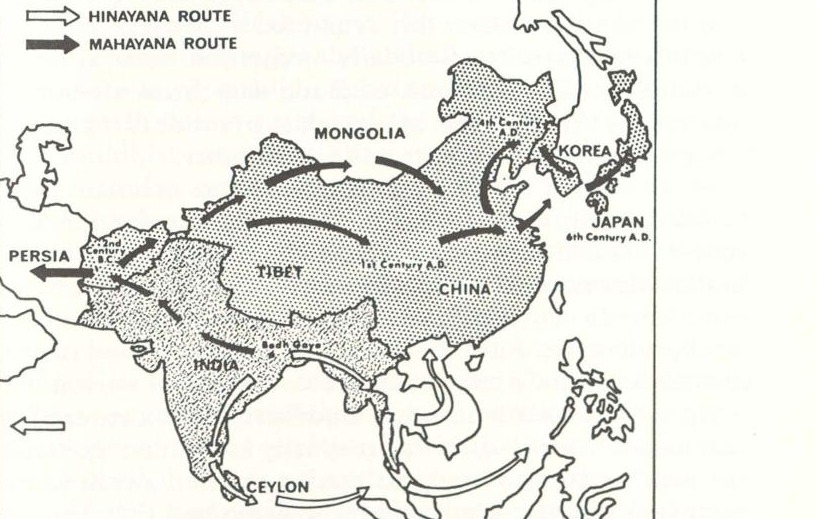
The Theravada teachings were among the first to be compiled, as they centered around precepts which were needed to regulate monastic communities. Later, as Buddhism spread more widely among the lay community, the Mahayana teachings, including the Lotus Sutra, were compiled.
Theravada in time became increasingly removed from the lay community and intent upon fine points of doctrinal investigation, and lost its vitality as a religious force. Mahayana, geared toward vigorous dissemination of the teachings and salvation for all, gradually gained momentum and emerged as a new religious movement.
Buddhism was probably introduced to China sometime before the birth of Christ, and several centuries’ effort at translation and study were begun. It was in China that Buddhism was systematized. Chih-i, also called T’ien-t’ai, a brilliant scholar of the sixth century, organized the entire body of sutras into a coherent philosophical system.
Both the Lotus Sutra and the Buddhism of T’ien-t’ai, which derived from it, speak of a true entity of fundamental law permeating all things. Both assert that all people can become Buddhas. But for the most part, this remained a theoretical proposition. Practice involved hours of daily meditation, and the subtleties of doctrine barred this form of Buddhism from all but the most learned. In theory it was universal; in practice it remained largely the province of the clergy and the nobility.
Soon after T’ien-t’ai’s death, Japanese scholars traveled to China to bring his teachings back to their homeland. Among these scholars was Saicho, later known as Dengyo. He brought this highest development of Buddhism by T’ien-t’ai back to Japan and established a center of learning at Mt. Hiei. He was responsible for a religious revolution that brought about a period of prosperity and highly sophisticated culture in the Heian period.
By the thirteenth century, Buddhism, now centered in Japan, had passed the zenith of its prosperity and, aided by natural disaster and social upheaval, entered a state of decline. Priests of opposing temples armed themselves, joined only by a common departure from the original Buddhist spirit.
The Shingon Sect, for example, incorporated a heavy element of ritual and mysticism to appeal to the aristocracy. The Jodo Sect offered deferred hopes to the suffering masses with promises of rebirth in the Pure Land. Buddhism had become a religion of escape.
Nichiren Daishonin and his true Buddhism
Into this rather confused state of religious affairs, Nichiren Daishonin was born on February 16, 1222 in a small fishing village on the eastern coast of Japan. As a young boy, he entered a temple near his home in order to receive an education, since the only schools at that time were the temples themselves. Eventually he entered the priesthood.
The young priest studied the sutras of Shakyamuni and wondered why so many different teachings had all come from the ideas of one sage. He was also troubled by the fact that no existing form of Buddhism had been able to truly help people find happiness in their daily lives—the one goal to which Shakyamuni had been committed.
With these questions in mind, Nichiren Daishonin set out to study all existing Buddhist thought. For sixteen years he traveled throughout Japan, studying at the highest centers of learning. As he studied he was especially concerned about the bewildering multiplicity of Buddhist sects and the doctrinal contradictions within the Buddhist canon. He was convinced that there must be one among the many sutras that represented the highest truth. He read all of the sutras and reviewed the teachings of T’ien-t’ai. Consequently, he came to the conclusion that the Lotus Sutra was the highest sutra and that its title, Myoho-renge-kyo, contained the entire essence of the sutra.
Very early in the morning of April 28, 1253, at Seicho-ji—the temple where he had begun his studies—the Daishonin chanted Nam-myoho-renge-kyo publicly for the first time. In doing this, he established a universal practice, opening the way to Buddhahood for all people. It was a practice so wondrously simple that anyone could do it, and yet so profound that it could unlock an infinite, enlightened wisdom in any individual. What he did, in essence, was enable the ordinary person to actualize in himself the reality described by centuries of Buddhist philosophy.
Throughout the Daishonin’s life, he refused to compromise in pointing out doctrinal errors and corruption in the religious world. This won him many enemies among both clerical and civil authorities, and he endured persecution throughout much of his life, including two exiles and an attempted execution. Nevertheless, he was able to solidify the foundation of his teaching for the generations to come through his indefatigable efforts at teaching his followers and writing down all the tenets of his true Buddhism. Ultimately, on October 12, 1279, he inscribed the true object of worship known as the Dai-Gohonzon in order to assure that mankind would eternally have a focus for the chanting of Nam-myoho-renge-kyo.
The establishment of a universally accessible means of practice marked a radical departure from previous forms of Buddhism and in this sense, Nichiren Daishonin’s teaching must be regarded as an entirely new religion, not merely an outgrowth of earlier forms.
His Buddhism was kept alive by a priesthood centered near Mt. Fuji for nearly 700 years. Then, when the post-World War II constitution brought freedom of religion to Japan, his followers were able to disseminate it freely. In recent years, Nichiren Shoshu (“orthodox school of Nichiren”) has spread to more than ninety countries, becoming a world religion.
Nichiren Daishonin himself added little to the theory of Buddhism. His achievement lay in another dimension. What he did was establish a practice whereby anyone might transform what was previously abstract and ideal theory into a concrete and beautiful reality of daily life. By analogy, one might think of previous Buddhist teachings as reams and reams of the most exquisite music which virtually no one had ever heard—because there was no instrument to play it. Nichiren Daishonin provided an instrument, and for the first time the music would resonate within and still people’s hearts. His contribution signaled a shift in the current of Buddhist history and a renaissance of the Buddhist spirit.
REFERENCES
Fundamentals of Buddhism. Y. Kirimura. Los Angeles: World Tribune Press, 1982.
Major Writings of Nichiren Daishonin, vol. 1. Edited and Translated by The Seikyo Times. Tokyo: Nichiren Shoshu International Center, 1979.
World Tribune: The Introductory Issue, “Buddhism: the Historical Perspective.” Los Angeles: World Tribune Press, February 8, 1982.